
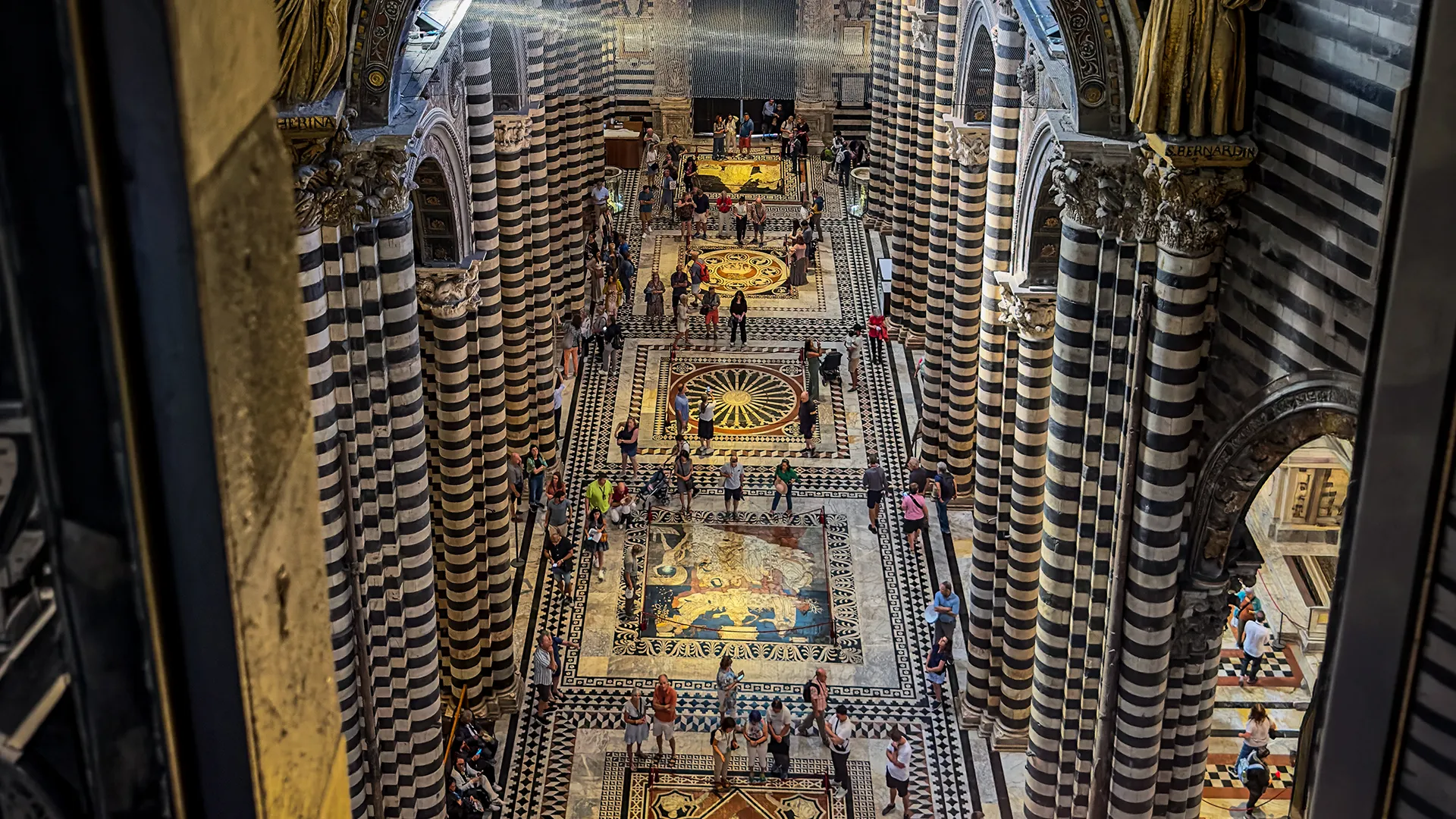
Siena Cathedral is not a monument that reveals itself all at once. Its striped marble walls, sculpted façade and soaring interior create an immediate impression, but some of its greatest treasures require a closer look. Beneath your feet lies an extraordinary narrative pavement; behind a doorway waits the vividly painted Piccolomini Library; throughout the complex, medieval and Renaissance artists left works that transformed Il Duomo into one of Tuscany’s richest artistic landmarks.
The cathedral also tells a larger story about Siena itself. Its black-and-white decoration recalls the city’s traditional colours, while its unfinished expansion reveals the ambition—and vulnerability—of the medieval republic. Artists including Nicola Pisano, Giovanni Pisano, Duccio, Pinturicchio, Donatello and Bernini contributed to the building or its decoration over several centuries.
This ten-question quiz explores the history, architecture and masterpieces of Il Duomo di Siena. Look beyond the striped columns and test how much you really know about the cathedral at the heart of Siena.
x of x
To which religious event is Siena Cathedral dedicated?
✅ Correct Answer: The Assumption of Mary
💡 Explanation: The cathedral’s full Italian name is Cattedrale metropolitana di Santa Maria Assunta. Its dedication to the Assumption of Mary is reflected throughout the building, including in Duccio’s stained-glass window and the Marian works once associated with the high altar.
Learn more
x of x
What do the cathedral’s alternating black and white marble stripes traditionally represent?
✅ Correct Answer: Siena’s civic colours
💡 Explanation: Black and white are the colours of Siena’s civic coat of arms. Local tradition also connects them to the black and white horses ridden by Senius and Aschius, the legendary founders of Siena. The striped marble therefore gives the cathedral a distinctly Sienese identity.
Learn more
x of x
What major event helped bring construction of Siena Cathedral’s enormous expansion to a halt in 1348?
✅ Correct Answer: The Black Death
💡 Explanation: Siena began an ambitious expansion in 1339 that would have turned the existing cathedral into the transept of a much larger church. Construction stopped during the Black Death of 1348, which devastated the city. Structural problems also affected the project, and the expansion was officially abandoned in 1355.
Learn more
x of x
Which artist oversaw much of the work on the cathedral’s lower western façade?
✅ Correct Answer: Giovanni Pisano
💡 Explanation: Giovanni Pisano directed work on the lower façade beginning around 1284. Its elaborate portals, sculpted figures and dramatic Gothic expression reflect his artistic vision, which was influenced by his father, Nicola Pisano. Most of the exterior statues visible today are copies, while the originals are preserved in the Museo dell’Opera del Duomo.
Learn more
x of x
Who created Siena Cathedral’s celebrated marble pulpit?
✅ Correct Answer: Nicola Pisano
💡 Explanation: Nicola Pisano and his workshop produced the Carrara marble pulpit between 1265 and 1268. Its densely populated reliefs portray episodes from the life of Christ and the Last Judgment. The work blends classical influences with the energy and emotional expression of northern Gothic sculpture.
Learn more
x of x
How many principal panels form the cathedral’s famous marble pavement?
✅ Correct Answer: 56
💡 Explanation:The pavement contains 56 panels created by approximately 40 artists between the 14th and 16th centuries. Its subjects include sibyls, biblical narratives, virtues, allegories and figures from the ancient world. Because many sections are protected by coverings for much of the year, seeing the entire floor uncovered requires careful timing.
Learn more
x of x
Which artist is principally responsible for the fresco cycle in the Piccolomini Library?
✅ Correct Answer: Pinturicchio
💡 Explanation:Pinturicchio and his workshop decorated the library with a brilliantly coloured fresco cycle portraying episodes from the life of Enea Silvio Piccolomini, who became Pope Pius II. The room was commissioned by Cardinal Francesco Todeschini Piccolomini to honour his uncle and preserve the family’s collection of manuscripts.
Learn more
x of x
Which Sienese artist created the monumental Maestà originally made for the cathedral’s high altar?
✅ Correct Answer: Duccio di Buoninsegna
💡 Explanation:Duccio created the Maestà between 1308 and 1311 as an immense double-sided altarpiece for Siena Cathedral. Its enthroned Virgin and Child reinforced the city’s devotion to the Virgin Mary. The work was later dismantled, and many surviving sections are now displayed in the Museo dell’Opera del Duomo.
Learn more
x of x
Which Baroque artist designed the gilded lantern above the cathedral’s dome?
✅ Correct Answer: Gian Lorenzo Bernini
💡 Explanation: Gian Lorenzo Bernini designed the gilded lantern that crowns the cathedral’s dome like a golden sun. Although Bernini is most closely associated with Baroque Rome, his contribution forms part of the many artistic layers added to Siena Cathedral after its medieval construction.
Learn more
x of x
What basic architectural shape does Siena Cathedral follow?
✅ Correct Answer: A Latin cross
💡 Explanation:The cathedral follows a Latin-cross plan, with a long nave intersected by a projecting transept. It also incorporates a dome rising from a hexagonal base and a bell tower built in the same striped marble language as the church. This arrangement gives the building both a strong processional axis and a dramatic central crossing.
Learn more
Your score is 3 out of 10.
🎯 Master of Il Duomo 👑 Magnifico! From the marble pavement to the unfinished expansion, Siena Cathedral holds few secrets from you.
🎯 Sienese Art Connoisseur 🎨 You can distinguish your Pisano from your Pinturicchio and understand why every corner deserves attention.
🎯 Duomo Explorer 🏛️ You know the cathedral’s major landmarks and are ready to examine its details more closely.
🎯 Cathedral Curious: 👀 The striped marble caught your eye, but Il Duomo still has plenty of secrets to reveal.
Siena Cathedral rewards more than a quick glance. Its striped marble establishes the visual identity of the building, but the deeper story unfolds through the details: Nicola Pisano’s expressive pulpit, Giovanni Pisano’s sculptural façade, Duccio’s Marian imagery and Pinturicchio’s brilliantly preserved frescoes. Even the unfinished walls of the planned expansion reveal something essential about Siena’s medieval confidence and the dramatic interruption caused by the Black Death.
The cathedral is also a reminder that great monuments are rarely the work of one architect, artist or generation. Il Duomo evolved over centuries, absorbing Gothic, Romanesque, Renaissance and Baroque contributions without losing its unmistakably Sienese character.
Whether you achieved a perfect score or discovered several unexpected facts, the best way to understand this landmark is slowly—looking upward, downward and behind every doorway. Continue your discovery with The Happy Traveler’s guide to Il Duomo di Siena.