
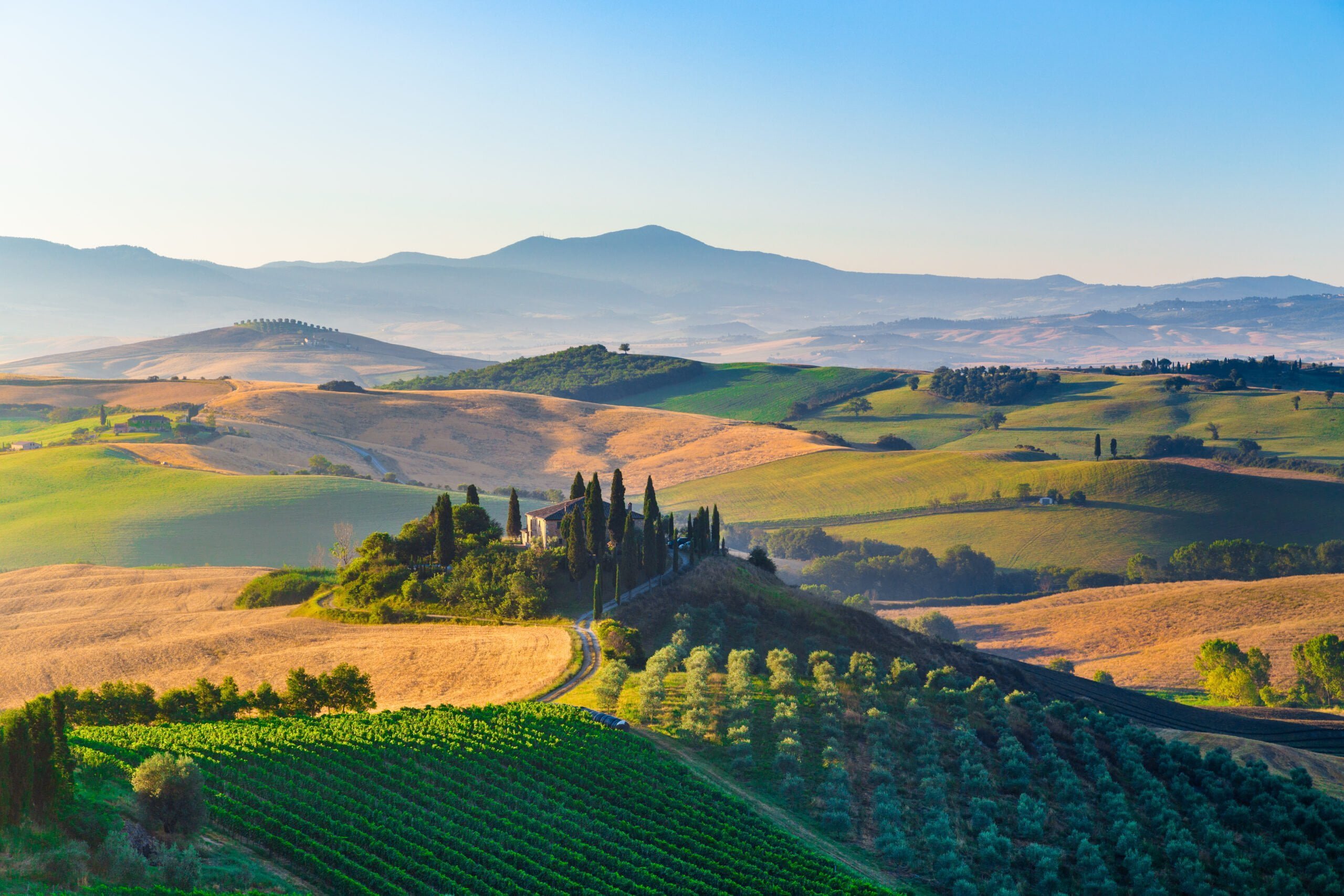
Rolling hills, cypress-lined roads, Renaissance towns, thermal springs and world-renowned wines have made the Val d’Orcia one of Tuscany’s most recognizable landscapes. But how much do you know about this UNESCO-listed valley?
Answer these 10 questions and discover whether you are a casual visitor or a true Val d’Orcia expert.
x of x
In which Italian region is the Val d’Orcia located?
✅ Correct Answer: Tuscany
💡 Explanation: The Val d’Orcia lies in southern Tuscany, primarily within the Province of Siena.
Learn more
x of x
In what year was the Val d’Orcia added to UNESCO’s World Heritage List?
✅ Correct Answer: 2004
💡 Explanation: UNESCO inscribed the Val d’Orcia in 2004 as a cultural landscape that reflects Renaissance ideas about beauty, land management and harmonious design.
Learn more
x of x
What was Pienza called before Pope Pius II had it rebuilt and renamed?
✅ Correct Answer: Corsignano
💡 Explanation: Pienza was originally known as Corsignano. Pope Pius II transformed his birthplace into an ideal Renaissance town and renamed it Pienza, meaning “city of Pius.”
Learn more
x of x
Which pope was responsible for transforming Pienza into an ideal Renaissance town?
✅ Correct Answer: Pope Pius II
💡 Explanation: Pope Pius II, born Enea Silvio Piccolomini, commissioned the rebuilding of Corsignano during the 15th century.
Learn more
x of x
Which celebrated wine is produced around Montalcino?
✅ Correct Answer: Brunello di Montalcino
💡 Explanation: Montalcino is internationally known for Brunello di Montalcino, one of Italy’s most prestigious DOCG red wines.
Learn more
x of x
Which grape variety must be used to make Brunello di Montalcino?
✅ Correct Answer: Sangiovese
💡 Explanation: Brunello di Montalcino is made entirely from Sangiovese. “Brunello” was once believed to be a separate local grape but was later identified as Sangiovese.
Learn more
x of x
What unusual feature occupies the centre of Bagno Vignoni?
✅ Correct Answer: A large thermal-water pool
💡 Explanation: Piazza delle Sorgenti is dominated by a large rectangular pool filled with thermal water. It gives Bagno Vignoni one of the most distinctive village centres in Italy.
Learn more
x of x
The Via Francigena, which passes through San Quirico d’Orcia, was historically used primarily by whom?
✅ Correct Answer: Pilgrims travelling toward Rome
💡 Explanation: The Via Francigena was an important medieval pilgrimage route connecting northern Europe with Rome. Its presence contributed to the development of San Quirico d’Orcia and Bagno Vignoni.
Learn more
x of x
Which historical figure is traditionally associated with the fortress of Radicofani?
✅ Correct Answer: Ghino di Tacco
💡 Explanation: The Rocca di Radicofani is traditionally associated with Ghino di Tacco, a medieval outlaw and nobleman later mentioned by Dante and Boccaccio.
Learn more
x of x
What type of geological formation is Monte Amiata?
✅ Correct Answer: Lava dome
💡 Explanation: Monte Amiata is the largest lava dome in the Amiata volcanic complex. Although it has not erupted during the Holocene, thermal and geothermal activity remains in the surrounding area.
Learn more
Your score is 3 out of 10.
🎯 Val d’Orcia Virtuoso 🏆 Magnifico! You could practically guide a slow-travel journey through the valley.
🎯 Tuscan Connoisseur 🍷 Impressive! You know your Renaissance towns, thermal springs and Sangiovese.
🎯 Val d’Orcia Wanderer 🚶 You know the main landmarks, but a few village secrets remain.
🎯 Tuscan Day-Tripper 🌱 You have only begun exploring the valley. Keep those cypress-lined roads on your travel list.
Whether you recognized Pienza’s Renaissance history or knew exactly what fills the centre of Bagno Vignoni, the Val d’Orcia rewards curiosity. Its villages, wines and landscapes are even more memorable when explored slowly.
Ready to discover it firsthand? Follow our journey from Siena through San Quirico d’Orcia and Montalcino.