
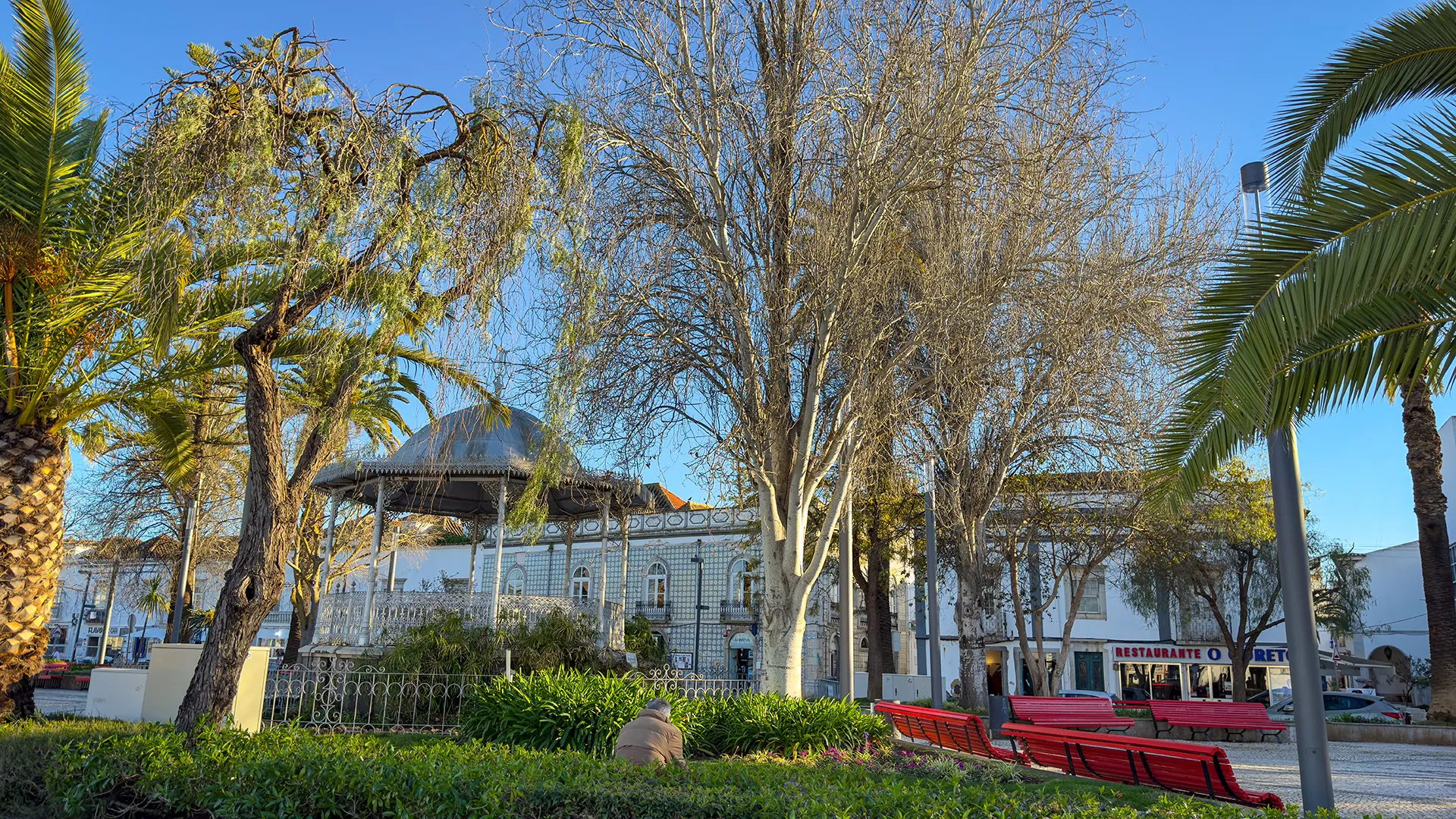
Some destinations invite you to keep moving. Tavira invites you to linger. In our winter guide, a simple day trip became an unhurried afternoon beside the river, where the pleasure of being somewhere mattered more than the number of sights visited. It is an approach that suits a town best discovered through its details rather than a hurried checklist. Read our Tavira in Winter guide.
This quiz begins in Tavira and explores the surrounding coast. Its questions connect the town’s river and medieval heritage with the islands, fishing traditions and coastal landscapes nearby. You will also discover how familiar sights—a salt pond, a collection of anchors or an optical attraction—can reveal unexpected stories.
Answer these ten questions to find out how well you know Tavira and its surroundings. Whether you are planning a first visit or remembering a favourite afternoon, there is always another layer to discover.
x of x
In which part of the Algarve is Tavira located?
✅ Correct Answer: The eastern Algarve
💡 Explanation: Tavira lies in the eastern Algarve, east of Faro and toward the Spanish border. That location makes it a useful starting point for exploring a different part of the region from the western coastline around Lagos and Sagres.
Learn more
x of x
Which river flows through central Tavira?
✅ Correct Answer: Gilão
💡 Explanation: The Gilão flows through Tavira and forms an important part of the town’s identity. Its presence helps explain Tavira’s historical relationship with maritime trade and gives visitors a natural reference point when exploring the centre.
Learn more
x of x
Which island lies just offshore from Tavira?
✅ Correct Answer: Ilha de Tavira
💡 Explanation: Ilha de Tavira lies a short distance south of the town and forms part of the Ria Formosa protected coastal landscape. Its long stretch of sandy beaches offers a contrast to the streets and monuments of the historic centre.
Learn more
x of x
Nearby Santa Luzia is especially associated with which seafood speciality?
✅ Correct Answer: Octopus
💡 Explanation: Santa Luzia is known as the capital do polvo, or “capital of octopus.” The speciality gives this community within Tavira municipality a distinctive culinary identity. Recognizing the word polvo is particularly useful when reading local menus.
Learn more
x of x
The ancient settlement of Balsa, near modern Tavira, is principally associated with which civilization?
✅ Correct Answer: The Romans
💡 Explanation: Balsa was a Roman town near modern Tavira, with a territory shaped by agricultural and maritime activity. It should not simply be treated as another name for the present town: its archaeological location is separate. Its history adds an ancient dimension to this part of the Algarve.
Learn more
x of x
What was the principal historical purpose of Castelo de Tavira?
✅ Correct Answer: To form part of the town’s defensive fortifications
💡 Explanation:Castelo de Tavira is a medieval castle occupying a commanding position above the town’s river setting. Its history includes Muslim rule and later Portuguese reinforcement. The surviving fortifications help explain why this elevated area mattered strategically.
Learn more
x of x
Why is Ria Formosa particularly important for birdwatching?
✅ Correct Answer: It provides important habitat and stopover areas for migratory birds.
💡 Explanation:Ria Formosa is an important wetland used by birds during migration. Its combination of lagoon waters, marshes and coastal habitats supports a varied bird population. Wildlife observation depends on the season and conditions, so a particular sighting should never be assumed.
Learn more
x of x
How is salt traditionally obtained from seawater in coastal salt ponds?
✅ Correct Answer: By allowing water to evaporate until salt crystallizes
💡 Explanation:Salt evaporation ponds concentrate dissolved salt as water evaporates, eventually allowing crystals to form. Sunlight and weather conditions influence the process. Understanding that principle makes salt-producing coastal landscapes easier to recognize and interpret.
Learn more
x of x
Tavira has a camera obscura attraction. What is the basic principle behind a camera obscura?
✅ Correct Answer: It projects an image of the outside world into a darkened space using light.
💡 Explanation: A camera obscura uses light entering through an opening or optical system to project an image inside a darkened space. The principle predates modern photography and does not require a digital video feed. Tavira’s attraction offers a different way to observe the town through this optical tradition.
Learn more
x of x
What does the collection of anchors at Praia do Barril commemorate?
✅ Correct Answer: The local tuna-fishing industry
💡 Explanation:The anchors at Praia do Barril were arranged as a memorial to the area’s former tuna-fishing industry. They were associated with the traditional almadrava fishing system. What first appears to be an unusual beach installation therefore preserves the memory of a working coastal community.
Learn more
Your score is 3 out of 10.
🎯 Tavira Virtuoso 🏆 Outstanding! From Balsa to Barril, you know how to uncover the stories behind the scenery.
🎯 Eastern Algarve Connoisseur 🐙 History, islands and local flavours—you are discovering much more than a pretty riverside view.
🎯 Riverside Explorer 🧭 You have found your bearings, but a few coastal stories are still waiting beyond the town centre.
🎯 Tavira First-Timer 👀 Your discovery is just beginning. Start beside the river and let curiosity choose the next stop!
Tavira becomes more interesting when you connect its different stories. The river belongs to a wider maritime landscape; the castle recalls the importance of defence; Balsa adds a Roman chapter; and the anchors at Barril preserve the memory of a fishing community. Even a menu in Santa Luzia or a salt pond beside the coast can become an opportunity to understand the region more deeply.
Your score is not the only thing to take away from this quiz. Perhaps one answer introduced a place you had not considered visiting, or gave a familiar sight a new meaning. Choose whichever discovery sparked your curiosity and use it as the beginning of further exploration—not another item to rush through.
For a firsthand introduction to the town’s quieter rhythm, continue with our Tavira in Winter guide. Sometimes the most memorable part of a visit is simply giving a place enough time to make an impression.